How to record inherited shares in your portfolio
Disclaimer: The below article is for informational purposes only and does not constitute a product recommendation, or taxation or financial advice and should not be relied upon as such. Please check with your adviser or accountant to obtain the correct advice for your situation.
Often attributed to Benjamin Franklin is the famous quote: "Nothing is certain except for death and taxes". Share inheritances combine these two certainties in a painful way. The grief of losing a loved one is difficult enough, but then comes the administrative burden of figuring out estate-related capital gains and tax information.
In this article we’ll cover a few things you might need to know should you inherit shares, as well as how to track those shares in Sharesight.

Do you pay tax on inherited shares?
The date of death of the relative who left you the shares is important to note. Many countries have inheritance or estate taxes at either the federal or state level. Among the OECD countries, the range varies from 55% in Japan and South Korea, to 0% in Australia and New Zealand.
In Australia you don’t have to pay any tax when inheriting shares or funds, but you may be liable for CGT if you sell them.
Tax after you inherit shares
Generally speaking, a capital gains event occurs whenever there is a transfer of ownership. The only exception is inheritance (it may be called by a different name depending on the country). After you have inherited shares, they need to be tracked in your portfolio. If the shares pay dividends, the income they generate will be taxed at your marginal income tax rate, and should you sell the shares, you will have to pay capital gains tax if your country has CGT laws in place.
How do I calculate the cost base for inherited shares?
Should you decide to sell a parcel of inherited shares, you will need to calculate the cost base for tax purposes. The cost base is the price at which the shares were bought.
Here’s an Australian example to explain the cost base for inherited shares. John lost his father on 13 July 2018, leaving him an inheritance that included a parcel of CBA shares. John’s father had bought 3000 CBA shares at $23.10 in 1999. The share price has gone up significantly since then, but the cost base of those shares is recorded as of the date of the original purchase by John’s father.
Another Australian example is that of Sarah. Sarah’s mother left her 200 shares in BHP on 13 June 2018, which she had acquired in 1980. In this case, because the original asset was acquired before 20 September 1985 when CGT was introduced in Australia, it is not subject to capital gains tax.
In Canada however, the fair value of the shares is assessed on the date they were inherited when calculating the cost base for a parcel of shares.
How to track inherited shares and funds in Sharesight
Inheritances have their own set of record-keeping requirements. For this purpose, it’s a good idea to track them separately from your other investments.
There are 2 features in Sharesight that can help achieve this outcome: Custom Groups, and Labels.
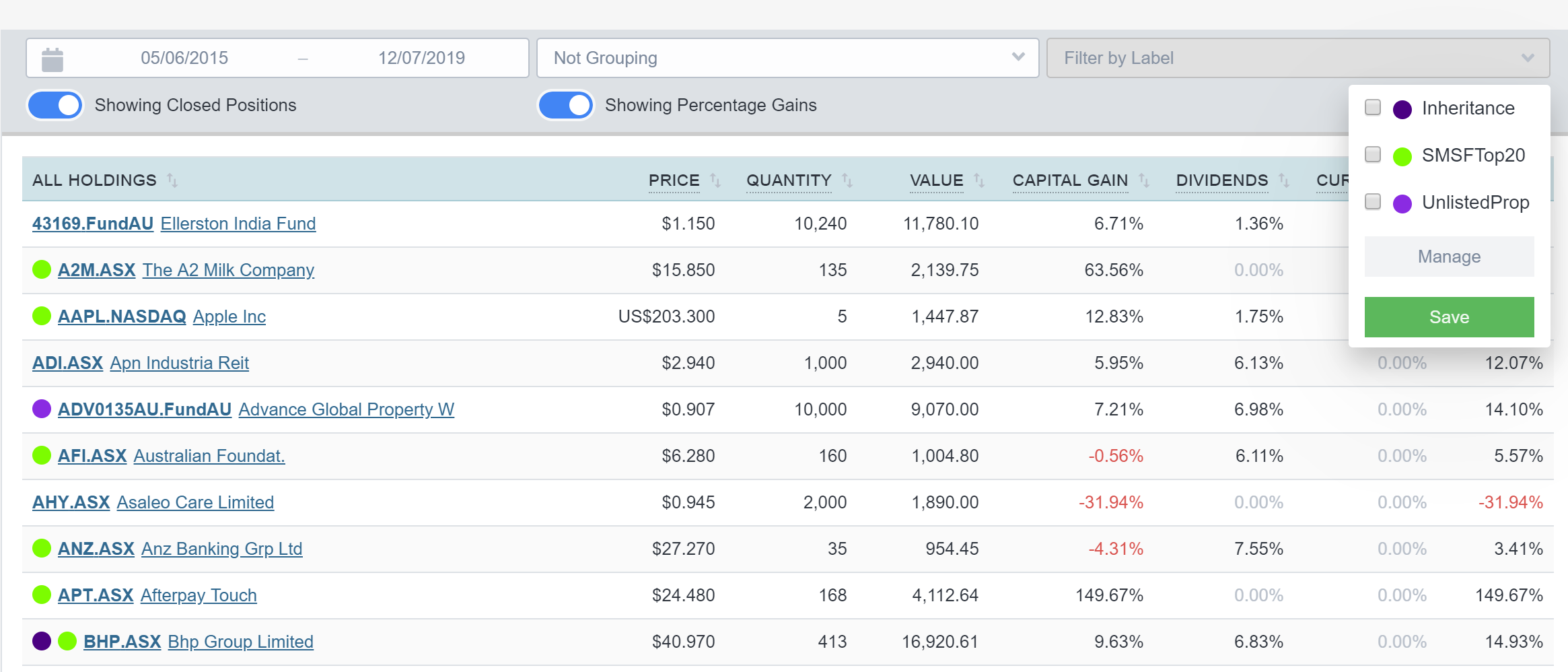
Sharesight Labels
Using the Labels feature in Sharesight, John can create a label called "Inheritance" in his portfolio, and assign his 200 BHP shares to that label. The label helps him identify the shares at a glance, and he can use the label to run the Performance Report on the particular holdings or exclude them to calculate the performance of his own “true” portfolio.
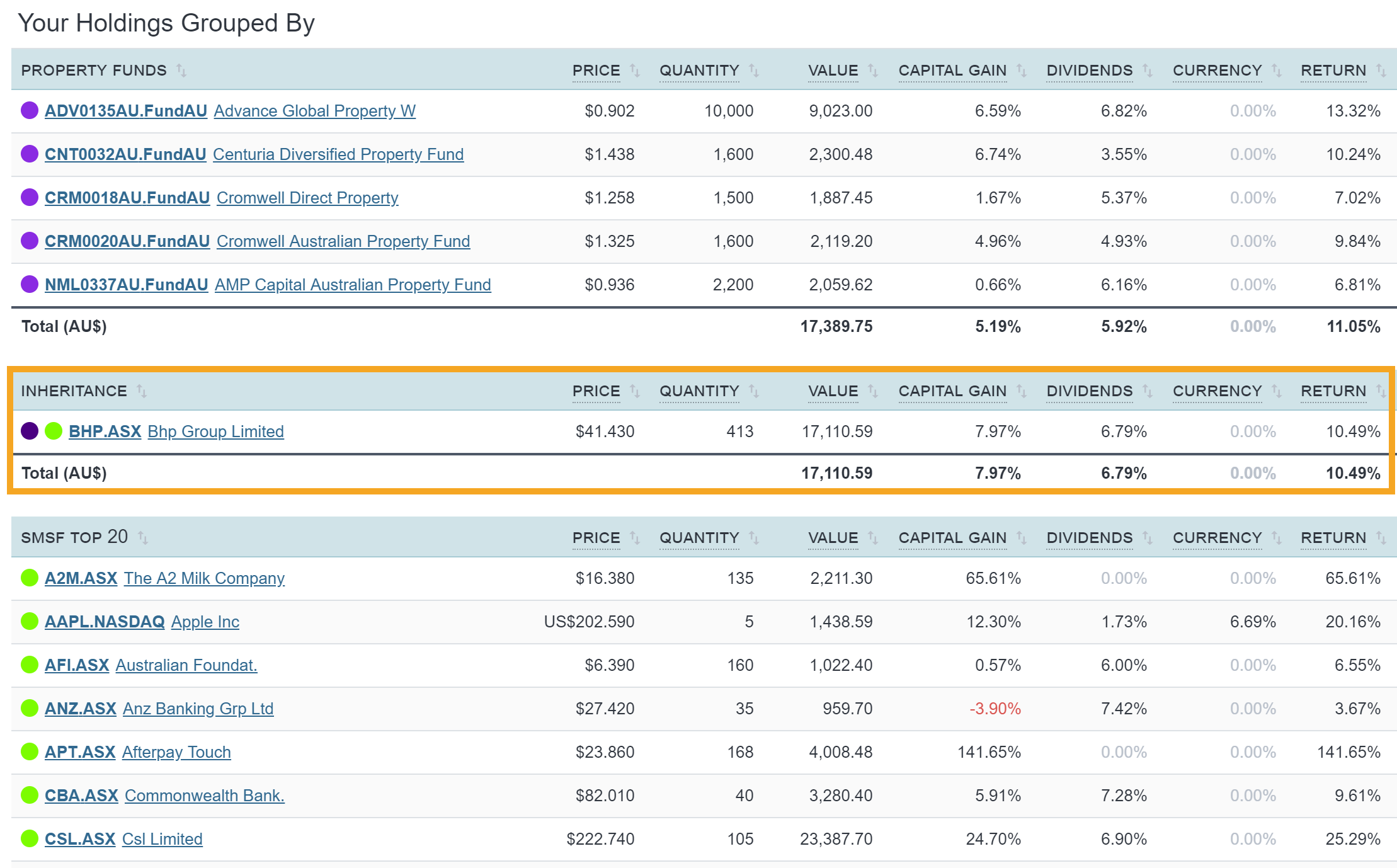
Custom Groups
Using the Custom Groups feature, a Sharesight user can visualise the group s/he has created. In this example we created an "Inheritance" group in Sharesight, as shown below.
Track inherited shares with Sharesight
The above features are only two of the ways Sharesight makes it easy to track inherited shares. With Sharesight you can:
-
Get the true picture of your investment performance, including the impact of brokerage fees, dividends, and capital gains with Sharesight’s annualised performance calculation methodology
-
Automatically track your daily price & currency fluctuations, as well as handle corporate actions such as dividends and share splits
-
Run powerful tax reports built for investors, including Capital Gains Tax (Australia and Canada), Unrealised Capital Gains, (Australia) and Taxable Income (All regions)
The best way to understand what Sharesight is all about is to sign up and try Sharesight for yourself. We’re confident that you’ll agree that it’s the best portfolio tracker for investors.
FURTHER READING


Product updates - September 2026
See what’s up and what’s down at a glance with our new gains & losses toggle, and more product improvements. It’s all in Sharesight’s September update.


August top trades: Apple ⬆️, Microsoft ⬇️ and Australians trade close to home 🇦🇺
Deep dive into the shares, stock and ETFs Sharesight’s investors bought and sold through August 2026, and stay up with the latest share trading trends.


Sharesight product updates – August 2026
This month's focus was on support for the Taipei Stock Exchange, franking credit estimates for Australian ETFs and a range of report improvements